
-

Computer Systems Technology
(Optional Co-op)
| Program Code: | CTY |
| Campus: | Seneca@York |
| Duration: | 6 Semesters (3 Years) |
| Start Dates: | Summer, Fall, Winter, Start dates are subject to change |
| Credential Awarded: | Ontario College Advanced Diploma |
Program Description
Seneca's School of Information and Communications Technology is a recognized leader in the Networking world. This program is built on partnerships with some of the most influential names in networking today – CISCO, IBM, Microsoft – and focuses on network design, LAN administration, and microcomputer support. Subjects in the first three semesters are identical to those of the Computer Networking and Technical Support (CNS) program. If you wish to transfer from the CNS to CTY program, you can do so without loss of credit. A valuable co–op option in the senior semesters gives you an opportunity to apply your learning to the real world. The fourth, fifth and sixth semesters expose you to advanced concepts and hands–on training in network design and optimization, advanced topics in security, data communication and voice over Internet protocols (VOIP), UNIX/ Linux administration, multi–player gaming administration, AS/400 operations and connectivity, and E–Commerce support.
CTY is a six–semester program, with required subjects available year–round. That means you can choose to complete your studies in six consecutive semesters, starting in the fall, winter or spring. Or you could take a break between semesters.
During the final three semesters, you’ll have the opportunity to focus on particular areas of interest, such as security, data communications or network administration, by choosing from a list of professional options. The list of options is updated regularly to reflect new technologies.
Program Learning Outcomes:
This Seneca College program meets the system-wide standards as set by the Ministry of Training, Colleges and Universities.
As a graduate, you will be prepared to reliably demonstrate the ability to:
- Analyze and resolve information technology problems through the application of systematic approaches and diagnostic tools.
- Analyze, plan, design, and implement computer systems.
- Analyze, plan, design, and implement networking solutions.
- Install, configure, troubleshoot, monitor, maintain, upgrade, and optimize computer systems.
- Install, configure, troubleshoot, monitor, maintain, upgrade, and optimize networks.
- Use a variety of scripting tools and languages to automate routine tasks.
- Participate in the deployment and administration of databases within a networked environment.
- Plan, develop, and be responsible for data storage to ensure the integrity of information.
- Apply knowledge of security issues to the implementation of information technology solutions.
- Appraise existing security solutions with a view to on-going maintenance, development, and improvement of organizational security.
- Provide efficient and effective technical support to clients in a manner that promotes safe computing practices and reduces the risk of the issue recurring.
- Articulate, defend, and conform to workplace expectations found in information technology (IT) environments.
- Contribute to the successful completion of the project applying the project management principles in use.
Essential Employability Skills:
Graduates of this program are also expected to demonstrate the essential employability skills learning outcomes as outlined on the Ministry of Training, College and Universities website.
Admission Requirements
Program Eligibility:
- Ontario Secondary School Diploma with a majority of senior credits at the College Preparation (C), University Preparation (U) or University/College Preparation (M) level or Mature Student Status (age 19 or older)
- Grade 12 English: ENG4(C) or ENG4(U)
- Grade 12 Mathematics: (C) or (U) or Grade 11 Mathematics (U) or (M)
Applicant Selection:
- Applicants may be ranked by previous academic achievement (i.e. grades in the pre–requisite English and Mathematics subjects or their equivalent).
Recommended:
- A home PC and Internet service provider (ISP) are highly recommended to be successful in this program since this is an activity–based program.
The Importance of Learning Skills:
Student success in college requires well developed learning skills (such as being able to work independently, participate in a team, be well–organized, develop good work habits, and show initiative). These skills are as important as prior academic achievement. While it is expected that applicants would have developed these skills through previous education and life experiences, Seneca offers support to assist students with further development of these important skills. Seminars, workshops and tutoring are available at Seneca's Learning Centres.
Fees
Your Career
Enjoy a fast–paced career as a technical support specialist, a booming area within the computer industry. Our Computer Systems Technology program will help you develop strong technical and interpersonal skills that will expand your employment opportunities in Voice Over IP, PC Technical Support, Network Administration, Helpdesk Support, Internet Resource Management, and other rapidly evolving areas that require technical support in networked environments.
Areas of Study
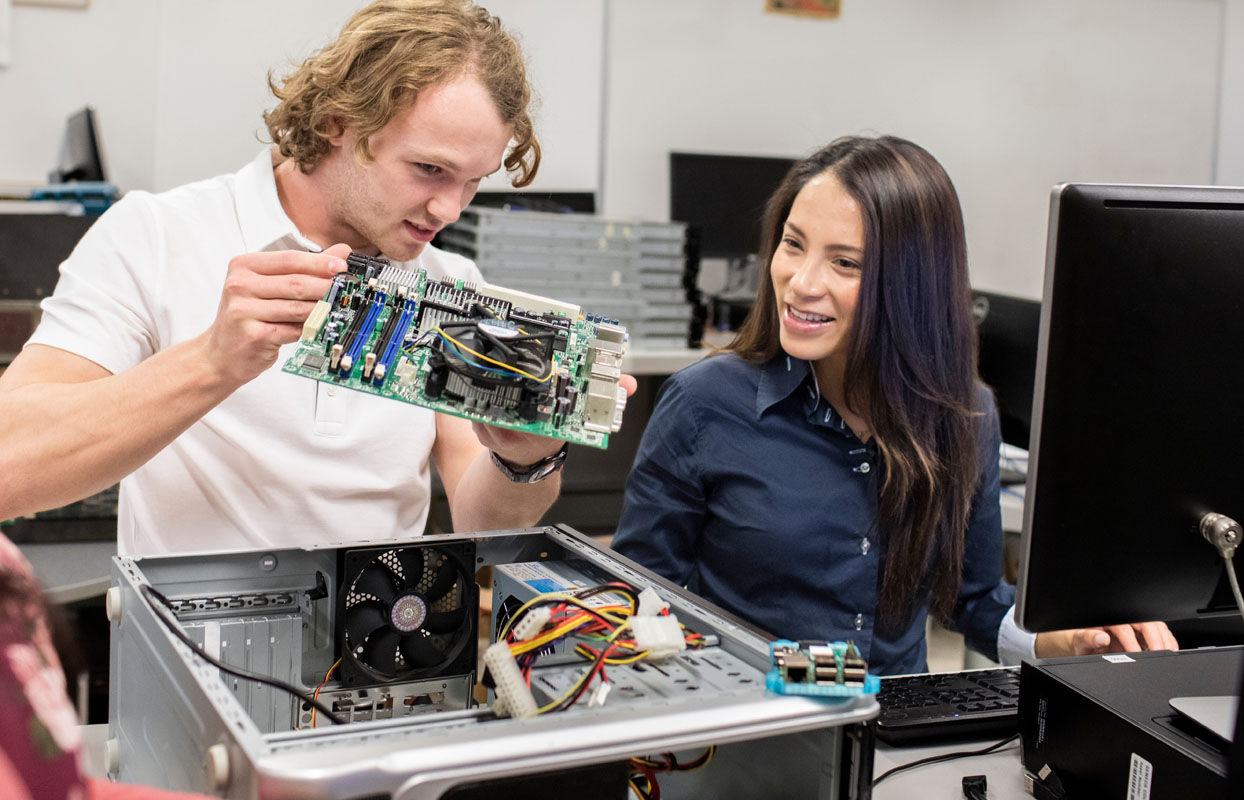
The Computer Systems Technology program is comprised of practical subjects and focuses specifically on hands–on training delivered in specialty labs. You’ll study in dedicated labs configured for environments such as Linux, Microsoft Windows, networking, PC hardware, Internet, and IBM System i. Through these labs, you’ll also gain access to stand–alone, clustered and networked PCs, along with a host of LAN servers and mid–range computers.
Your subjects will include PC hardware, operating systems, Internet, HTML, UNIX/Linux and Microsoft Windows Server administration, data communications, Novell Netware, AS/400 connectivity, web server installation and maintenance, Voice over Internet Protocol and Security. In semesters four, five and six you may select from a broad offering of professional options and you’ll get to integrate your systems and technical skills in the planning and implementation of a "real–life" computer project for a business client.
And finally, you’ll benefit from experience with our industry partners’ innovative products first–hand. CISCO, Microsoft and Novell are all present in our labs. Work with them in class or use the open learn areas to practice your work outside of class. You’ll even have 24/7 access to Seneca’s extensive computing services from external sites.
Open Source and Seneca
Seneca's Centre for Development of Open Technology (CDOT) has unparalleled connections with top–tier open source projects such as Mozilla, creators of the Firefox web browser, and Red Hat, makers of the most successful commercial Linux operating system. In SBR 600, students have the opportunity to work with world class developers on such projects.
General Education
One of the general education subjects must be a literature subject for which EAC150 is the pre-requisite.
For more information, please visit: http://els.senecac.on.ca.
Co-operative Education Option
Co–op can be a valuable experience for CTY students, so you’ll have the opportunity to apply after your second semester. After three semesters of college studies, you may secure paid work–terms in the computer networking and technical support industry, alternating between academic and work semesters.
Our industry partners are committed to providing meaningful work assignments for co–op students. You could gain up to eight months of paid employment experience. Entry to the co–op program and work–terms can occur in each of three semesters (Fall, Winter or Spring). If selected for the co–op program, you must maintain above average academic standards for progression in co–op.
Students in the co–op option will also take CPP100 (Co–op Professional Theory) in the semester preceding their first co–op work– term, and CPP200 (Co–op Professional Practice) in the semester following their first co–op work–term. Students must successfully complete two co–op work–terms to graduate from the co–op option.
For further information about the co–op program, please refer to Co–operative Education, Faculty of Technology at www.senecacollege.ca/coop. Co–op information sessions are held at the Seneca@York campus throughout the year.
Diploma to Degree... and Beyond
Through transfer agreements and institution partnerships, graduates of this Seneca College program may be eligible for credit at the following post-secondary institution(s):
Toronto
| University/College | Degrees Available |
|---|---|
| Ryerson University | • Bachelor of Commerce, Business Technology Management – Direct-Entry program |
| Seneca College | • Bachelor of Technology, Informatics and Security • Bachelor of Technology, Software Development |
| York University | • Any relevant major |
Ontario
| University/College | Degrees Available |
|---|---|
| McMaster University | • Bachelor of Technology, Computing and Information Technology |
| University of Ontario Institute of Technology | • Bachelor of Information Technology (Honours) - Networking and Information Technology Security – Direct Entry |
| University of Windsor | • Bachelor of Computer Science (General) or Bachelor of Computer Science (Honours Applied Computing) |
Canada
| University/College | Degrees Available |
|---|---|
| Athabasca University | • Bachelor of Science – Computer and Information Systems (Post Diploma) |
U.S.
| University/College | Degrees Available |
|---|---|
| Davenport University | • BSc – Technology Management – Global IT Project Management |
International
| University/College | Degrees Available |
|---|---|
| Griffith University | • Bachelor of Information Technology |
| Queensland University of Technology | • Bachelor of Information Technology |
Curriculum
| Semester 1 | Subject Name | Hrs/Wk |
|---|---|---|
| APC100 | Applied Professional Communications | 3 |
| EAC150 | College English | 3 |
| HWD101 | PC Hardware I | 5 |
| ICA002 | Introduction to Computers and Applications | 2 |
| IOS110 | Introduction to Operating Systems Using Windows | 5 |
| ULI101 | Introduction to UNIX/Linux and the Internet | 5 |
| Semester 2 | Subject Name | Hrs/Wk |
| DCN286 | Introduction to Data Communication Technology | 4 |
| INT213 | Active Server Pages Using Visual Basic | 4 |
| OPS235 | Introduction to Open System Servers | 4 |
| WIN210 | Basic Administration of Microsoft Windows | 5 |
| XXXXXX | General Education Option | 3 |
| Semester 3 | Subject Name | Hrs/Wk |
| DAT702 | Introduction to Databases | 5 |
| DCN386 | Advanced Data Communications Technology | 4 |
| EAC397 | Business Report Writing | 3 |
| OPS435 | Open System Automation | 4 |
| WIN310 | Microsoft Windows Network Infrastructure | 5 |
| XXXXXX | General Education Option | 3 |
| Semester 4 | Subject Name | Hrs/Wk |
| INT420 | Internet II | 4 |
| NDD430 | Network Diagnostics and Design | 6 |
| OPS335 | Open System Application Server | 5 |
| XXXXXX | Professional Option | 4 |
| XXXXXX | Professional Option | 4 |
| XXXXXX | General Education Option | 3 |
| Semester 5 | Subject Name | Hrs/Wk |
| CIS701 | Cisco Networking Academy Training I | 5 |
| SEC520 | Internet Security | 4 |
| XXXXXX | Professional Option | 4 |
| XXXXXX | Professional Option | 4 |
| XXXXXX | Professional Option | 4 |
| Semester 6 | Subject Name | Hrs/Wk |
| APL701 | Applied Integration | 4 |
| INT620 | Applied E-Commerce | 4 |
| XXXXXX | Professional Option | 4 |
| XXXXXX | Professional Option | 4 |
| XXXXXX | Professional Option | 4 |
Professional Options
The following list is a snapshot of professional option choices available in the last three semesters. New and revised subjects will be offered each semester based on the demands of the rapidly changing computer industry. Up–to–date information may be retrieved from the School of Information and Communications Technology website at scs.senecacollege.ca.
| Professional | Subject Name | Hrs/Wk |
|---|---|---|
| DCN686 | Configuring Cisco Devices | 4 |
| DCN704 | Voice Over IP | 4 |
| DCN706 | Wireless and Mobile | 4 |
| INT525 | Advanced Implementation Using Apache | 4 |
| IPC144 | Introduction to Programming Using C | 5 |
| OPS400 | AS/400 Operations | 4 |
| OPS535 | Open System Clustering - Advanced Network Administration | 4 |
| OPS650 | AS/400 Connectivity | 4 |
| PHP701 | PHP Scripting | 4 |
| SBR600 | Software Build and Release | 4 |
| SEC625 | Information System Security | 4 |
| SEC701 | Ethical Hacking | 4 |
| SEC703 | Advanced Security | 4 |
| TEC701 | Technical Support for Network Administrators | 4 |
| TEC702 | Technician as an Entrepreneur | 4 |
| WIN500 | Windows Server Scripting | 4 |
| WIN700 | Windows Active Directory Services | 4 |
Note: Not all options will be offered every semester, and offerings will be dependent on sufficient enrolment.
Contact Us
| School of Computer Studies: Website: http://cs.senecacollege.ca Email: els@senecacollege.ca |
|
| Program Coordinators: | Scott Apted Telephone: (416) 491-5050 Ext. 33386 Email: Scott.Apted@senecacollege.ca |
| Co-op Coordinator: | Elizabeth Piergeti Telephone: (416) 491-5050 Ext. 33350 Email: Elizabeth.Piergeti@senecacollege.ca |
| Program Chairs: | Evan Weaver Telephone: (416) 491-5050 Ext. 33211 Email: Evan.Weaver@senecacollege.ca Mary-Lynn Manton |
| Admissions Advisors: | |
| Domestic Admissions Advisor: | TBA Telephone: (416) 491-5050 Ext. 22840 Email: admissions@senecacollege.ca |
| International Admissions Advisor: | Susan Gao Telephone: (416) 491-5050 Ext. 22365 Email: Susan.Gao@senecacollege.ca |
| Registration & Records Advisor: | Ingrid Huizing Telephone: (416) 491-5050 Ext. 33007 Email: Ingrid.Huizing@senecacollege.ca |
Apply Online
Request Info
Video

Paul talks about his education, the support he received at Seneca and being part of the research team that created the Fedora Arm software used on the popular Raspberry Pi computer.

