
Contact Us Sign In
  • Aviation Technology Degree

    Aviation Technology Degree

(Co-op)

Program Code:FPR
Campus:Newnham, Markham, Buttonville
Duration:8 Semesters (4 Years)
8 academic semesters plus 2 intensive flight training semesters (4 Years), 1 summer co-op work term
Start Dates:Fall,
Start dates are subject to change
Credential Awarded:Bachelor of Aviation Technology

Program Description

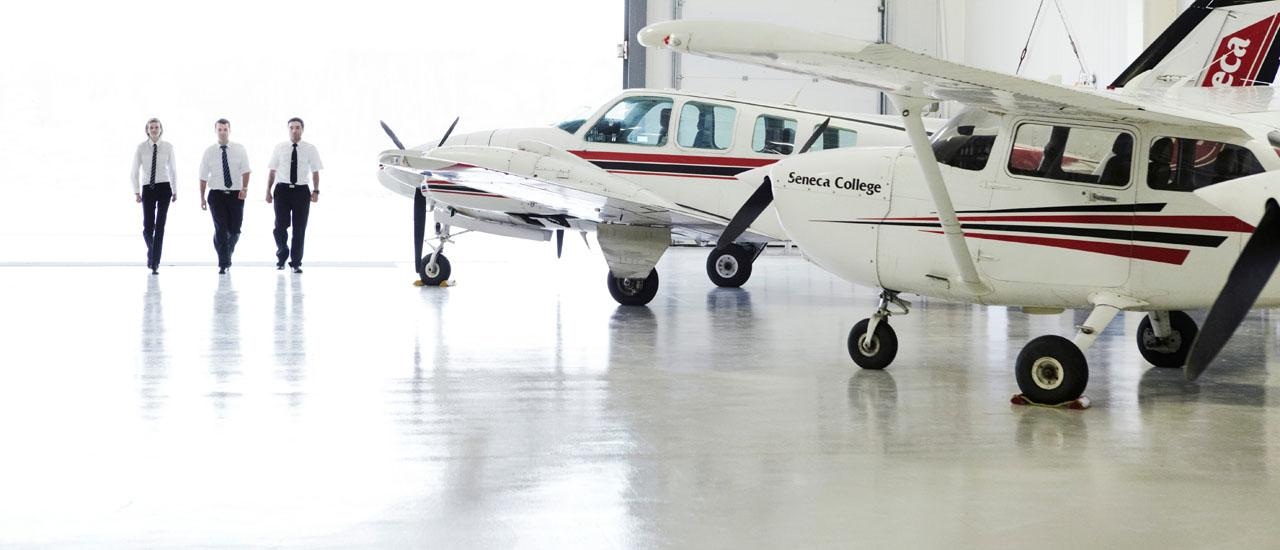
Seneca's Bachelor of Aviation Technology program is the only aviation technology–based degree program in Canada. We’ve been the national leader in aviation education for more than 40 years and responding to emerging industry demands, we’re now educating students at the degree level.

Our Bachelor of Aviation Technology program provides a rigorous aviation technology–based curriculum and the application of this theory to aviation. The breadth of knowledge and skills prepares you to operate safely in a complex aircraft, to understand the technologies and human factors that affect the successful operation of an aircraft and to assume the professional responsibility associated with being a commercial pilot.

You’ll also learn business management, airport operations and planning, and air carrier administration to gain a "larger sense" of the aviation industry and ultimately access a greater variety of careers in the industry.

Program Learning Outcomes:

As a graduate, you will be prepared to reliably demonstrate the ability to:

  • Independently fly and safely operate multi–engine airplanes;
  • Demonstrate a comprehensive understanding and the appropriate application of aerospace principles, airplane design, airplane characteristics, operational limitations, aerodynamic principles and airplane properties for a variety of airplanes and designs;
  • Conduct yourself professionally and ethically and promote a professional pilot image;
  • Be confident with automation, complex equipment and technically challenging systems and with the verification of status, level and programming of automated systems;
  • Maintain safe operating conditions for all geographical areas and flying conditions;
  • Communicate effectively and concisely ideas, directions, and operations, in written and oral communications;
  • Use effective stress–management strategies;
  • Demonstrate appropriate and effective decision making skills;
  • Demonstrate effective leadership and motivation skills.

Essential Employability Skills:

Graduates of this program are also expected to demonstrate the essential employability skills learning outcomes as outlined on the Ministry of Training, College and Universities website.

Admission Requirements

Program Eligibility:

  • Ontario Secondary School Diploma with a majority of senior credits at the University Preparation (U) or University/College Preparation (M) level or Mature Student Status (age 19 or older)
  • Six Grade 12 (U) or (M) courses with a minimum 65% average including:
    • Grade 12 English: ENG4(U)
    • Grade 12 Mathematics: Calculus and Vectors MCV4(U)
    • Grade 12 Mathematics: Advanced Functions MHF4(U)
    • Grade 12 Physics: SPH4(U)
  • Candidates must attend a mandatory College orientation session
  • Candidates who are offered admission to the program must also pass a medical examination administered by a physician designated by the College and a drug and alcohol test, prior to starting classes at Seneca. In order to pass the medical examination, candidates must meet Transport Canada’s Physical and Mental Requirements Category 1.
  • Mature students (age 19 years or older) must submit proof of credits in the above subjects or their equivalent.

Recommended:

  • Grade 11 (U) Chemistry

Applicant Selection:

  • In addition to grades in the required subjects, applicants must attend a mandatory College orientation session and complete given assignments and/or tests. Those offered admission must pass a medical exam administered by a designated Transport Canada Aviation Medical Examiner, pass a drug and alcohol test and must not have any criminal convictions that would preclude them from holding an airport security clearance.
  • Please note it is common practice for the Aviation Industry to require police criminal checks and drug testing on employment. Due to these industry requirements the College has changed its entrance requirements to address these practices.
  • In order for students to fly to the United States during their flight training, it is strongly recommended that students have a valid Canadian passport or a United States entrance visa.

Restrictions:

  • Persons holding a Commercial Pilot Licence may not be eligible for the FPR program. Contact the Program Director for further information. Scholarship opportunities are available for candidates with distinguished academic records in their high school careers. A variety of scholarships and bursaries are available to students based on merit and financial needs.

The Importance of Learning Skills:

Student success in college requires well developed learning skills (such as being able to work independently, participate in a team, be well–organized, develop good work habits, and show initiative). These skills are as important as prior academic achievement. While it is expected that applicants would have developed these skills through previous education and life experiences, Seneca offers support to assist students with further development of these important skills. Seminars, workshops and tutoring are available at Seneca's Learning Centres.

Fees

Loading Tuition Costs

Your Career

The Bachelor of Aviation Technology program puts you at the leading edge of aviation training. As a graduate of this program, you will be well–positioned to compete in the global market as a professional pilot in general aviation and with regional air carriers, later progressing to corporate aviation and major airlines. The breadth and depth of the program mean that you could also pursue exciting careers in government regulatory agencies, airport authorities, flight test and evaluation, aircraft manufacture and marketing, and the aviation insurance industry.

In addition to traditional technological and flight competencies, the aviation industry is increasingly demanding management and interpersonal skills. Our Crew Resource Management and Human Factors training help develop these competencies and the result is that this degree program is ideally positioned to meet the future requirements of the Canadian and global aerospace industry. Every year we’re graduating technically competent future managers and leaders.

Your career options will increase with experience and many graduates can expect a progression to management ranks over time. You’ll also have the opportunity to pursue additional studies at the graduate level. Details on these opportunities are available from the Program Director.

Degree Structure


Year 1
Term 1: September: Academic
Term 2: January: Academic / Flight Training
Term 3: May: Intensive Flight Training

Year 2
Term 1: September: Academic / Flight Training
Term 2: January: Academic / Flight Training
Term 3: May: Intensive Flight Training or co-operative education work term

Year 3
Term 1: September: Academic / Flight Training
Term 2: January: Academic / Flight Training
Term 3: May: Intensive Flight Training or co-operative education work term

Year 4
Term 1: September: Academic / Flight Training
Term 2: January: Academic / Flight Training

Co-operative Education

Students in the Flight Program benefit from a full-time consecutive co-operative education work experience. One successful (as indicated by the learning outcomes for co-operative education work terms) work term of 14 weeks is required for graduation. This work term may be taken during Term 3 of either Year 2 or Year 3.

Flight Training

This program is a Transport Canada approved Integrated Airline Transport Pilot training program that prepares students to be Commercial Airline Pilots. Intensive flight and simulator training is an integral part of this rigorous degree program. Eight semesters of flight training is a required component of the program. Two of these Intensive training semesters will occur during the summer months.

Students who are unable to achieve a satisfactory rating in their flight training after a set number of attempts, will be withdrawn from the FPR program and will be ineligible for re–admission. Please note that flight training is carried out seven days per week and students will be required to fly weekends during their training.

Tuition

Tuition fees for this program are significantly higher than other college degree programs. Fees include tuition and Flying classes.

For more detailed information, please see the 2012/2013 Fee Policies for this program:

Promotion Policy

Attendance to all classes is a Transport Canada requirement for promotion. Students must pass all Transport Canada exams, which have higher pass grades.

In accordance with PEQAB requirements, this program has a minimal overall acceptable achievement for progression.

Curriculum

Semester 1 Subject Name Hrs/Wk
AER100 Aeronautics Fundamentals 4
COM100 Communications 4
ELE100 Electricity Fundamentals 5
ISR104 Computer Fundamentals 3
MEC110 Mechanics 4
MTH110 Mathematics 4
 
Semester 2 Subject Name Hrs/Wk
AER200 Advanced Aeronautics 4
ELE200 Fundamentals of Electronics 4
MEC200 Mechanics II 4
MTH200 Mathematics II 4
PHY200 Physics 5
AND
XXXXXX Liberal Studies Elective 3
OR
FLY100 Flight Training 14
 
Summer 1 Subject Name Hrs/Wk
XXXXXX Liberal Studies Elective 3
OR
FLY100 Flight Training 14
 
Semester 3 Subject Name Hrs/Wk
AVN300 Instruments and Avionics Fundamentals 3
CHM300 Chemistry 5
FLY200 Flight Training 8
MET400 Meteorology 3
MTH300 Mathematics 3
MTS300 Materials Science 3
XXXXXX Liberal Studies Elective 3
 
Semester 4 Subject Name Hrs/Wk
ARO400 Fundamentals of Aerodynamics 4
ASD400 Aircraft Structural Design 3
AVN400 Advanced Instruments and Avionics 3
COM400 Technical Writing 3
FLY300 Flight Training 8
IRT500 Instrument Rating Procedures 4
THE300 Thermodynamics 3
CPP600 Co-op Professional Practice 2
 
Summer 2 Subject Name Weeks
FLY400 Summer Flying Practicum 14
  OR  
CWT100 Co-op Work Term 14
 
Semester 5 Subject Name Hrs/Wk
ARO500 Advanced Aerodynamics 3
ASY500 Basic Aircraft Systems 3
BAB100 Introduction to Canadian Business 3
FLP500 Flight Propulsion 4
FLY400 / FLY500 Flying 8
HUM500 Human Factors Ethics and Safety 3
CPP700 Co-op Integration and Career Planning 1
 
Semester 6 Subject Name Hrs/Wk
AAS700 Advanced Aircraft Systems 3
ACP700 Air Carrier Procedure 3
ASC600 Aircraft Stability and Control 3
BAB700 Management Principles and Practices 3
CPA600 Computer Programming Aerospace 2
FLY500 / FLY600 Flying 8
SMS600 Safety Management System 3
CPP600 Co-op Professional Practice 2
 
Summer 3 Subject Name Weeks
FLY400 Flying 14
  OR  
CWT100 Co-op Work Term 14
 
Semester 7 Subject Name Hrs/Wk
ADM600 Air Carrier Administration 3
ADV700 Advanced Aircraft Design 3
FLO600 Flight Operations I 3
FLY700 / FLY800 Flying 8
FSL100 Introductory French I 3
LSP700 Applied Research Methodology 3
CPP700 Co-op Integration and Career Planning 1
 
Semester 8 Subject Name Hrs/Wk
ADV800 Advanced Aircraft Design 3
AOP800 Airport Planning 3
FLO800 Flight Operations II 3
FLY800 / FLY900 Flying 8
LSP800 Applied Research Project 4
XXXXXX Liberal Studies Elective 3

* Students will take one option in Semester 2 and the other in Summer 1.

Seneca has been granted a consent by the Minister of Training, Colleges and Universities to offer this degree for a 5-year term starting September 8, 2008. In conformity with the Minister’s criteria and requirements, Seneca will submit an application for the renewal of the consent for this program 12 months prior to the expiration of the consent. Seneca shall ensure that all students admitted to the above-named program during the period of consent will have the opportunity to complete the program within a reasonable time frame.

Contact Us

Admissions Advisors:
Domestic Admissions Advisor: Eva Qadeer
Telephone: (416) 491-5050 Ext. 22802
Email: Eva.Qadeer@senecacollege.ca
International Admissions Advisor: Erica Yudelman
Telephone: (416) 491-5050 Ext. 22758
Email: Erica.Yudelman@senecacollege.ca
Student Advisor: Diana Samuel-De Roche
Telephone: (416) 491-5050 Ext. 22765
Email: Diana.Samuel-DeRoche@senecacollege.ca
Program Coordinator: Adel Labib
Telephone: (416) 491-5050 Ext. 26585
Email: Adel.Labib@senecacollege.ca
Co-op Coordinator: Tracy Rogers
Telephone: (416) 491-5050 Ext. 26833
Email: Tracy.Rogers@senecacollege.ca
Program Chair: Lynne McMullen
Telephone: (416) 491-5050 Ext. 22176
Email: Lynne.McMullen@senecacollege.ca
Registration & Records Advisors:  
Year 1 (Newnham Campus): Hamza Ansari
Telephone: (416) 491-5050 Ext. 22470
Email: Hamza.Ansari@senecacollege.ca
Years 2-4 (Markham Campus): Steve Bennett
Telephone: (416) 491-5050 Ext. 77434
Email: Steve.Bennett@senecacollege.ca

Request Info

Video

Flight Program

Flight student Kaitlynn talks about a typical day for students at Seneca's Buttonville Airport campus. Video

Graduate Success

A day after graduating from Seneca’s Bachelor of Aviation Technology program, Martin Diaz was hired as a Boeing 727 Second Officer with Cargojet Airways, Canada's leading provider of air cargo services.

Testimonials

"In this age of globalization, the aviation industry is a major player. Airlines are also looking for a good educational background for pilot hiring as modern aircraft and crew need to be managed well for a safe flight. It is no longer sufficient to be able to fly the aircraft well. Your proposed degree syllabus appears to address many of the challenges the new pilots will be facing. They will have a solid knowledge of the complex components they will be operating and also the principles governing all phases of the operation. I congratulate you and Seneca College for making this farsighted proposal and wish you success in your enterprise."

Manzur Huq
Director, General Aviation
Transport Canada

"We are very conscious of the change in aviation training within the North American context. Our counterparts within the USA industry have been strong supporters of a comprehensive aviation degree. We are of the same mind and congratulate you for considering a similar aviation degree within Canada."

R.T. Deane
Director, Flight Operations Training
Air Canada

"When I applied to Seneca's School of Aviation and Flight Technology, I thought it was the best decision that I could make. When I landed my dream job, a few months after graduation, I knew I had made the right choice. Now that I have been working in the industry, I can see why the Bachelor of Aviation Technology Program and its graduates have such a highly regarded reputation. The school's experienced and diverse faculty know what it takes to be successful in aviation and do an incredible job of preparing students for their future careers."

Daryl Wood
FPR Graduate
Co–pilot, Air Canada Jazz

Seneca College of Applied Arts and Technology Edit Page