Skip navigation
Text only
Mechanical Techniques (Tool and Die/Mould Making)

Mechanical Techniques (Tool and Die/Mould Making)

(Pre-apprenticeship for Tool & Die Maker, Mould Maker, and General Machinist)

Program Code: MATTCampus: Jane
Duration: 2 semesters (1 Year)Start Dates: Fall
Start dates are subject to change
Credential Awarded: Ontario College Certificate

Program Description

Graduates from this program are eligible to write the exemption test for Level 1/Common Core and Level 2 in one of the following trades: Tool & Die Maker, Mould Maker, and General Machinist, as specified by the Ministry of Training, Colleges and Universities. This program will introduce you to modern manufacturing techniques including Computer Numerical Control (CNC) Programming and Computer Assisted Manufacturing (CAM) software. This computer training will enhance your ability to produce accurate work on CNC equipment found in today’s modern metal and plastics industries. Upon completion of this program, you may begin an apprenticeship with an employer as a General Machinist, Tool & Die Maker, or Mould Maker. Once the remaining apprenticeship training requirements have been completed, you’ll be eligible to write the Certificate of Qualifications (C of Q) examination in your chosen trade.

After graduation, you can transfer directly into the second year of Mechanical Engineering Technician - Tool Design program or the third year of Mechanical Engineering Technology - Industrial Design program.

Program Learning Outcomes:

This Seneca College program meets the system-wide standards as set by the Ministry of Training, Colleges and Universities.

As a graduate, you will be prepared to reliably demonstrate the ability to:

  • Complete all work in compliance with current legislation, standards, regulations and guidelines.
  • Contribute to the application of quality control and quality assurance procedures to meet organizational standards and requirements.
  • Comply with current health and safety legislation, as well as organizational practices and procedures.
  • Support sustainability best practices in workplaces.
  • Use current and emerging technologies to support the implementation of mechanical and manufacturing projects.
  • Troubleshoot and solve standard mechanical problems by applying mathematics and fundamentals of mechanics.
  • Conntribute to the interpretation and preparation of mechanical drawings and other related technical documents.
  • Perform routine technical measurements accurately using appropriate instruments and equipment.
  • Assist in manufacturing, assembling, maintaining and repairing mechanical components according to required specifications.
  • Select, use and maintain machinery, tools and equipment for the installation, manufacturing and repair of basic mechanical components.

Essential Employability Skills:

Graduates of this program are also expected to demonstrate the essential employability skills learning outcomes as outlined on the Ministry of Training, College and Universities website.

Admission Requirements

Program Eligibility:

  • Ontario Secondary School Diploma with a majority of senior credits at the College Preparation (C), University Preparation (U) or University/College Preparation (M) level or Mature Student Status (age 19 or older)
  • Grade 12 English: ENG4(C) or ENG4(U)
  • Grade 12 Mathematics*: MCT4(C) Mathematics for College Technology (recommended grade 60% or over) or Grade 12 (U) Mathematics, MHF4(U) (Advanced Functions) or MCV4(U) (Calculus and Vectors)

* Seneca may also consider applicants with good grades in MAP4(C) or MCR3(U).

Note: All applicants who are offered admission to programs in the Faculty of Applied Science and Engineering Technology will have an English and Mathematics skills assessment. The assessments are used for academic placement in English and Mathematics courses that are appropriate to the student’s skill level. In the event a preparatory course is required before enrolling in the standard semester one English or Mathematics, students will automatically be timetabled into the appropriate preparatory course.

Applicant Selection:

  • In the event of oversubscription, assignments given at an orientation, previous academic achievement and grades in prerequisite subjects (or their equivalents) may be used to select candidates.

The Importance of Learning Skills:
Student success in college requires well developed learning skills (such as being able to work independently, participate in a team, be well-organized, develop good work habits, and show initiative). These skills are as important as prior academic achievement. While it is expected that applicants would have developed these skills through previous education and life experiences, Seneca offers support to assist students with further development of these important skills. Seminars, workshops and tutoring are available at Seneca's Learning Centres.

Your Career

There is a need for apprenticed personnel in the metal machining trades in Ontario. After completing your apprenticeship, you may pursue fulfilling careers such as tool designer, supervisor, company owner, salesperson, or numerical control programmer.

Areas of Study

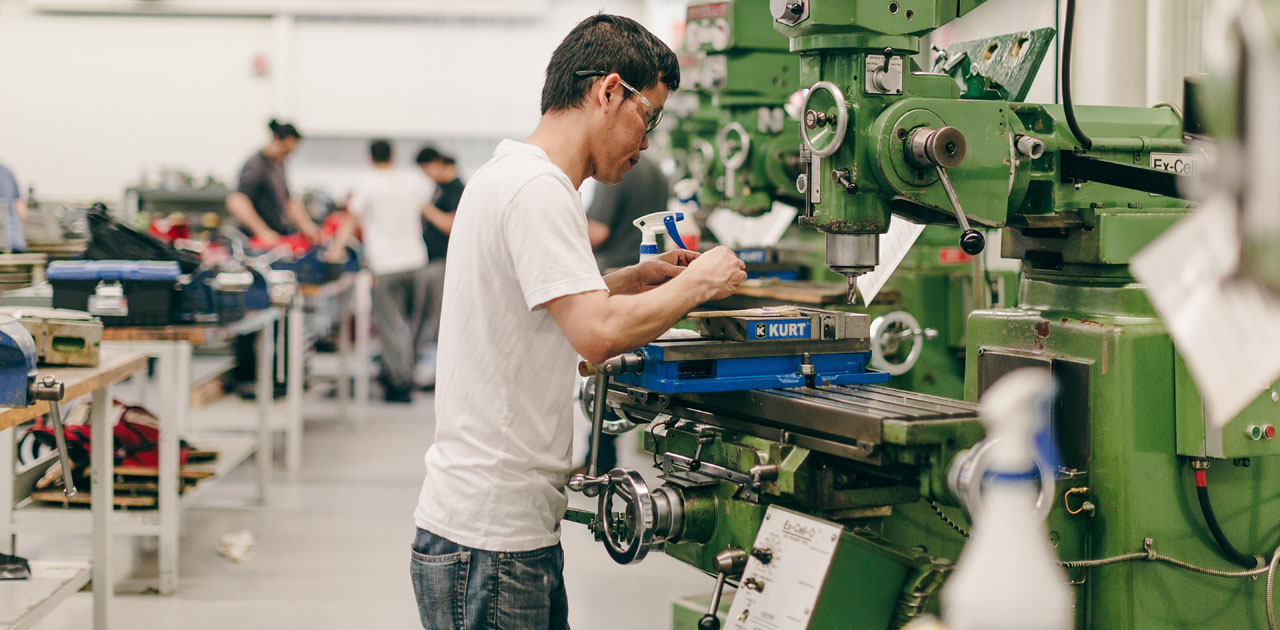
In the MATT program, you’ll study both the theory and practical aspects of metal machining. Subjects of study include all areas required by the apprenticeship branch of the Ministry for the Level 1/Common Core and Level 2 in-school components for general machinist, tool and die maker and mould maker trades. Areas of study include bench fitting, metallurgy, interpreting engineering drawings, mathematics, and machine theory and practice, as well as an introduction to Computer Numerical Control (CNC) and Computer Aided Manufacturing (CAM).

Curriculum

Semester 1 Subject Name Hrs/Wk
BPR101 Blueprint Reading 2
CNC101 Computer Numerical Control 2
EAC150 College English 3
ICA001 Introduction to Computers and Applications 2
MTH101 Mathematics 2
SHP101 Shop 13
THY101 Machining Theory 3
 
Semester 2 Subject Name Hrs/Wk
CAM201 Computer Assisted Machining 2
MTH201 Technical Mathematics I 2
SHP201 Shop 13
THY201 Machining Theory 3
TLD201 Tool Design 2
XXXXXX General Education Option 3

Contact Us

For more information, please visit our website: http://cpst.senecacollege.ca.
Program Chair: Ken Ellis
Telephone: (416) 491-5050 Ext. 22250
Email: Ken.Ellis@senecacollege.ca
Program Coordinator: Romel Cipriani
Telephone: (416) 491-5050 Ext. 44361
Email: Romel.Cipriani@senecacollege.ca
Admissions Advisors:
Domestic Admissions Advisor: Margaret Lim
Telephone: (416) 491-5050 Ext. 22806
Email: Margaret.Lim@senecacollege.ca
International Admissions Advisor: Aakashni Ram
Telephone: (416) 491-5050 Ext. 22085
Email: Aakashni.Ram@senecacollege.ca
Registration & Records Advisor: Milad Tabataba
Telephone: (416) 491-5050 Ext. 22470
Email: Milad.Tabataba@senecacollege.ca

Videos

Centre for Advanced Technology graduates discuss career options

Students Fabrizio and Brian discuss the options available to graduates of the programs at Seneca College's Centre for Advanced Technologies - Jane Campus. Video


Learn more about the state-of-the-art equipment used at the Centre:

Co-ordinate Measuring Machine
This machine can measure to 1/10 of a thousandth-of-an-inch. Video


Stereo Lithography Machine
Program Co-ordinator Romel Cipriani talks about this "printer" that creates three dimensional objects. Video


White Light Scanner
Fabrizio and Program Co-ordinator Romel Cipriani Scanning explain how the scanner turns objects into computer files. Video


Wire Electrical Discharge Machine
Program Co-ordinator Romel Cipriani explains how steel is cut with a wire. Video