-

Mechanical Engineering Technology - Industrial Design
| Program Code: | MIT |
| Campus: | Jane |
| Duration: | 6 Semesters (3 Years) |
| Start Dates: | Fall, Start dates are subject to change |
| Credential Awarded: | Ontario College Advanced Diploma |
Program Description
The Mechanical Engineering Technology – Industrial Design program will provide you with the skills and knowledge to design and develop products and devices that may be offered for retail or commercial sale.
Many good ideas and inventions fail simply because the inventor does not have the means to take his/her concept sketches through the basic design, engineering, production and marketing stages that are required before a customer can purchase a finished article.
You'll learn machining and production techniques, rapid prototyping, principles of mechanical design, engineering analysis, marketing, basic accounting practices, engineering design analysis, negotiating techniques, entrepreneurial skills, ergonomics, basic electricity and electronics.
The program will provide you with several career options and educational pathways. Upon graduation from this three–year advanced diploma program, you'll be prepared to enter modern manufacturing environments, or you may choose to undertake freelance consulting or development work of your own. You’ll also have the option to complete the first year of the program, receive a certificate in Mechanical Techniques and enter an apprenticeship as a Tool and Die Maker, Mould Maker or General Machinist. Alternatively, you may choose to complete the first two years of the program, receive a Mechanical Engineering Technician diploma and obtain a position as a Tool or Mould Designer. This concept of laddering will allow you flexibility and the option to increase your level of education incrementally.
Program Learning Outcomes:
This Seneca College program meets the system-wide standards as set by the Ministry of Training, Colleges and Universities.
As a graduate, you will be prepared to reliably demonstrate the ability to:
- Monitor compliance with current legislation, standards, regulations and guidelines.
- Plan, co-ordinate, implement and evaluate quality control and quality assurance procedures to meet organizational standards and requirements.
- Monitor and encourage compliance with current health and safety legislation, as well as organizational practices and procedures.
- Develop and apply sustainability best practices in workplaces. • use current and emerging technologies to implement mechanical engineering projects.
- Analyze and solve complex mechanical problems by applying mathematics and fundamentals of mechanical engineering
- Prepare, analyze, evaluate and modify mechanical engineering drawings and other related technical documents.
- Design and analyze mechanical components, processes and systems by applying fundamentals of mechanical engineering.
- Design, manufacture and maintain mechanical components according to required specifications.
- Establish and verify the specifications of materials, processes and operations for the design and production of mechanical components.
- Plan, implement and evaluate projects by applying project management principles.
- Develop strategies for ongoing personal and professional development to enhance work performance.
- Apply business principles to design and engineering practices.
Essential Employability Skills:
Graduates of this program are also expected to demonstrate the essential employability skills learning outcomes as outlined on the Ministry of Training, College and Universities website.
Admission Requirements
Program Eligibility:
- Ontario Secondary School Diploma with a majority of senior credits at the College Preparation (C), University Preparation (U) or University/College Preparation (M) level or Mature Student Status (age 19 or older)
- Grade 12 English: ENG4(C) or ENG4(U)
- Grade 12 Mathematics*: MCT4(C) Mathematics for College Technology (recommended grade 60% or over) or Grade 12 (U) Mathematics, MHF4(U) (Advanced Functions) or MCV4(U) (Calculus and Vectors)
* Seneca may also consider applicants with good grades in MAP4(C) or MCR3(U).
Note: All applicants who are offered admission to programs in the Faculty of Applied Science and Engineering Technology will have an English and Mathematics skills assessment. The assessments are used for academic placement in English and Mathematics courses that are appropriate to the student’s skill level. In the event a preparatory course is required before enrolling in the standard first semester English or Mathematics, students will automatically be timetabled into the appropriate preparatory course or will be counselled to enroll in the Applied Science and Technology Fundamentals Certificate Program.
The Importance of Learning Skills:
Student success in college requires well developed learning skills (such as being able to work independently, participate in a team, be well–organized, develop good work habits, and show initiative). These skills are as important as prior academic achievement. While it is expected that applicants would have developed these skills through previous education and life experiences, Seneca offers support to assist students with further development of these important skills. Seminars, workshops and tutoring are available at Seneca's Learning Centres.
Fees
Your Career
Pursue a career as an Industrial Designer or a Tool and Die/Mould Designer or Tool and Die/ Mould Maker with this six–semester advanced diploma program. You’ll learn to design and develop products and devices that may be offered for retail or commercial sale. Your career could include modern manufacturing design environments, freelance consulting or independent development.
FAST TRACK into Semester 3
If you have prior post–secondary education in Mechanical Engineering or other related technology disciplines you may qualify to FAST TRACK your studies through direct entry into the second year of this program. The granting of credits beyond semester two is possible in exceptional cases. FAST TRACK entry may, at the discretion of the department, be offered to partially qualified candidates, in conjunction with requirements to complete additional subjects from semesters one or two.
Diploma to Degree... and Beyond
Through transfer agreements and institution partnerships, graduates of this Seneca College program may be eligible for credit at the following post-secondary institution(s):
Ontario
| University/College | Degrees Available |
|---|---|
| McMaster University | • Bachelor of Technology, Energy Engineering Technologies • Bachelor of Technology, Manufacturing Engineering Technology |
| University of Ontario Institute of Technology | • Bachelor of Applied Science in Nuclear Power (Honours) – Bridge Program |
Canada
| University/College | Degrees Available |
|---|---|
| Cape Breton University | • Bachelor of Engineering Technology – Manufacturing • Bachelor of Engineering Technology – Petroleum |
Curriculum
| Semester 1 | Subject Name | Hrs/Wk |
|---|---|---|
| BPR101 | Blueprint Reading | 2 |
| CNC101 | Computer Numerical Control | 2 |
| EAC150 | College English | 3 |
| ICA001 | Introduction to Computers and Applications | 2 |
| MTH101 | Mathematics | 2 |
| SHP101 | Shop | 13 |
| THY101 | Machining Theory | 3 |
| Semester 2 | Subject Name | Hrs/Wk |
| CAM201 | Computer Assisted Machining | 2 |
| MTH201 | Technical Mathematics I | 2 |
| SHP201 | Shop | 13 |
| THY201 | Machining Theory | 3 |
| TLD201 | Tool Design | 2 |
| XXXXXX | General Education Option | 3 |
| Semester 3 | Subject Name | Hrs/Wk |
| HPN301 | Hydraulics and Pneumatics | 3 |
| JFX301 | Jig and Fixture Design | 4 |
| MAN301 | Manufacturing Processes I | 4 |
| MDD301 | Mould Design | 4 |
| MTH301 | Technical Mathematics II | 4 |
| PLC301 | PLC Electrical Control Systems | 3 |
| XXXXXX | General Education Option | 3 |
| Semester 4 | Subject Name | Hrs/Wk |
| DIE401 | Die Design | 4 |
| EAC392 | Effective Business and Technical Writing | 3 |
| EST401 | Estimating | 3 |
| MAN401 | Manufacturing Processes II | 4 |
| MCD401 | Machine Design | 4 |
| QLA401 | Quality Assurance CMM | 4 |
| SHP401 | Machine Shop | 3 |
| Semester 5 | Subject Name | Hrs/Wk |
| ACC501 | Management Accounting | 2 |
| ELF501 | Electricity | 3 |
| IND501 | Industrial Design Ergonomics | 3 |
| MAN501 | Project Management | 3 |
| MKM501 | Marketing Fundamentals | 2 |
| MTH501 | Software Mathematics | 4 |
| PRD501 | Prototype Management | 4 |
| Semester 6 | Subject Name | Hrs/Wk |
| ADM601 | Advanced Modeling Design Techniques | 4 |
| BMK601 | Brand Management | 2 |
| EEA601 | Engineering Analysis | 4 |
| ETR601 | Electronics | 3 |
| IBL601 | Industrial Business Law and the Patent System | 2 |
| MKM601 | Entrepreneurship | 2 |
| XXXXXX | General Education Option | 3 |
Contact Us
| For additional information, please visit our website. | |
| Admissions Advisors: | |
| Domestic Admissions Advisor: | Margaret Lim Telephone: (416) 491-5050 Ext. 22806 Email: Margaret.Lim@senecacollege.ca |
| International Admissions Advisor: | Erica Yudelman Telephone: (416) 491-5050 Ext. 22758 Email: Erica.Yudelman@senecacollege.ca |
| Program Coordinator: | Romel Cipriani Telephone: (416) 491-5050 Ext. 44361 Email: Romel.Cipriani@senecacollege.ca |
| Registration & Records Advisor: | Hamza Ansari Telephone: (416) 491-5050 Ext. 22470 Email: Hamza.Ansari@senecacollege.ca |
| Program Chair: | Ken Ellis Telephone: (416) 491-5050 Ext. 22250 Email: Ken.Ellis@senecacollege.ca |
Apply Online
Request Info
Videos

Students Fabrizio and Brian discuss the options available to graduates of the programs at Seneca College's Centre for Advanced Technologies - Jane Campus. Video
Learn more about the state-of-the-art equipment used at the Centre:
Co-ordinate Measuring Machine
This machine can measure to 1/10 of a thousandth-of-an-inch. Video
Stereo Lithography Machine
Program Co-ordinator Romel Cipriani talks about this "printer" that creates three dimensional objects. Video
White Light Scanner
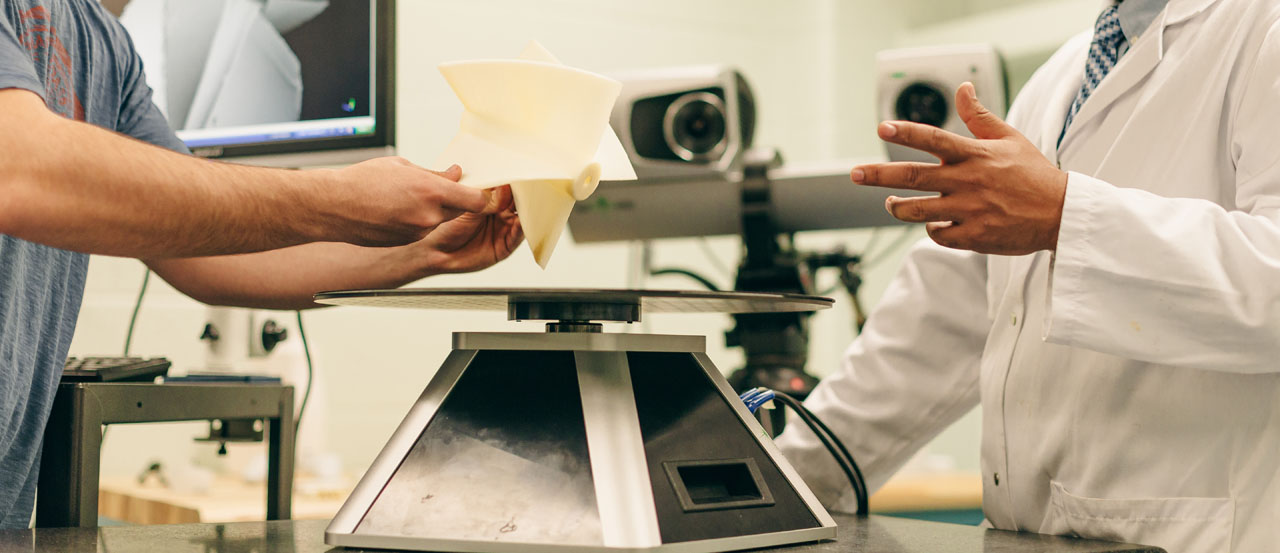
Fabrizio and Program Co-ordinator Romel Cipriani Scanning explain how the scanner turns objects into computer files. Video
Wire Electrical Discharge Machine
Program Co-ordinator Romel Cipriani explains how steel is cut with a wire. Video